




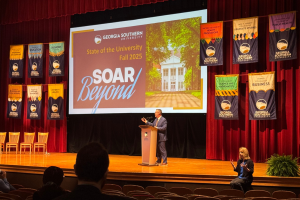
Georgia Southern University President Kyle Marrero delivered the annual “State of the University” address at Armstrong on Sept. 9, sharing progress on the East Georgia State consolidation, announcing record-breaking enrollment numbers, and touching on challenges presented by rapid growth and policy change.
Opening the address, President Marrero acknowledged some of the difficulties felt across higher education institutions, as shifting federal, state and university system policies have called for prompt “alignment and adaptation”.
“This is my thirteenth year as a president, seventh year here. The last eight months, there’s been more policy change, and change, than my entire career. In eight months,” Marrero said.
He said the “State of the University” address is a time of reflection on the challenges facing the university, to speak about and recognize them, and ask, “How do we ensure we’re serving our students and communities?”
East Georgia Consolidation
Marrero regarded other recent changes as both hurdles and great opportunities for growth, including the consolidation of East Georgia State College.
“We learned a lot,” He said, comparing the current merger with East Georgia to the university’s first consolidation with Armstrong State University. “We have 152 team members of the different 17 consolidation action teams working through this.”
He reported that 67 percent of the 495 identified tasks for the consolidation are complete, and highlighted the university’s humanistic approach to this merger, “That really honors and understands the people that are involved.” Final approval of the prospectus is slated for Dec. 2025, and consolidation is to be effectively implemented by Jan. 2026.
In contrast to the consolidation with Armstrong, where athletics were dissolved because Georgia Southern was unable to host two National Collegiate Athletic Association (NCAA) programs, the East Georgia campus will retain athletic programs by transitioning to National Association of Intercollegiate Athletics (NAIA) programs.
Marrero stated that the East Georgia campus will remain open-access through consolidation, ensuring that students who don’t meet some of the criteria for admission to Georgia Southern will still be able to access higher education pathways.
Alexis Smith, SGA vice president of business & finance, also emphasized a collaborative approach to incorporating East Georgia State students into the Eagle family in her introductory remarks on behalf of the Student Body.
“We’re beginning to build meaningful connections with East Georgia State. These conversations are about collaboration, sharing ideas, and ensuring that when the time comes for us to move forward together, the transition feels smooth, supportive and student-focused,” she said.
Marrero reported that about 220 East Georgia students showed up to the recent “State of the College” address.
Enrollment, Achievements and Finances
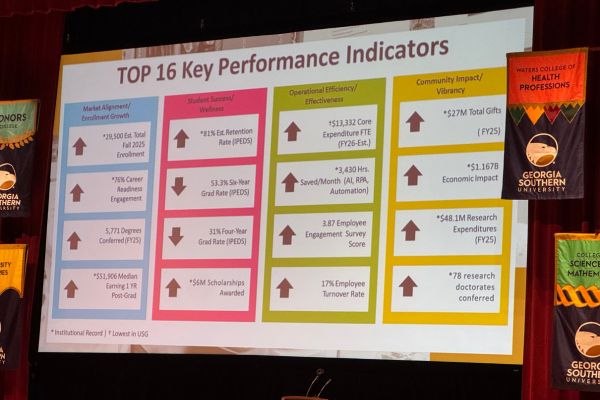
President Marrero shared the record-setting enrollment numbers for fall 2025, totalling more than 29,500 students this semester. Preliminary enrollment metrics show 9,387 new students this semester, 5,891 being first-time freshmen.
Five new Ph.D. programs have been introduced to Georgia Southern, with another hopefully being incorporated in October. Georgia Southern is closely pursuing Carnegie R1 status, with Marrero stating that a three-year projection for conferred doctorate degrees exceeds the required annual average target of 70 to achieve the title. Falling just short of the required $50 million in research expenditures in the previous fiscal year, an amount exceeding $56 million is projected for this fiscal year.
Marrero rejoiced in the success of the first capital campaign, “Together We Soar“, which supports initiatives in student success, teaching and public research, athletics and campus and community enrichment.
“We said, crazily, Georgia, Southern by 2026… is going to raise $125 million. Well, last spring, we surpassed this. We’re already at $133.5 million, and we’ve reset the campaign to $300 million by the end of 2030.” He said. “We have 5,022 of our alumni that were donors last year. That’s a record to the institution.”
He reports cost-of-living salary increases, distributed through the direction of University Systems, provided an increase of $377,000 divided across 177 faculty and staff salaries this year. In perspective, he stated that “Over the last five years, with COLA, cost of living increases, and then also salary market equity, which we’ve invested, $20 million recurring has been invested in salaries at Georgia Southern for our faculty and staff.”
“Is it enough? No. Do we need to do more? Yes, but what I can tell you is the state and us have made it a priority,” he said, continuing that new prospects in organizational efficiency and effectiveness will help redirect funds into “our core mission of academic curriculum delivery and teaching.”
“How do we automate? How do we digitize? How do we do robotic process organization to save the institution funds?” he asked. He stated that the university’s electric bill had increased by $2 million over the last year.
Marrero pointed to new AI Technology modeled in 15 Georgia Southern buildings in Statesboro that are piloting an automated system as a part of the future solution, implementing proactive infrastructural repairs and resource optimization. “This will save us $2 million,” he said.
Challenges and Visions for the Future
President Marrero said that the upcoming fall 2026 semester presents many variables and challenges, as test scores are reintroduced to admission criteria and the university strives to improve students’ college and career readiness.
He connected these enrollment market challenges, student readiness, and the hurdles involved in consolidation to the continuing effort of previous initiatives, as well as new long-term goals.
Marrero highlighted the Ready Day 1 Connect initiative for the student-employee transition, pursuing the goal of infusing “career skills and a career mindset into our academic offerings, so that students leave this university knowing what they need to do to be successful in obtaining a career and go on to great achievements.”
Moving forward, Marrero proposes a renewed focus on the public research impact agenda that focuses on seven sectors: logistics and supply chain management, advanced material and manufacturing, coastal resilience, holistic fitness and wellness, vibrant communities, sustainable fuels and integrated community health.
“We are going to continue to incentivize and reward interdisciplinary and transdisciplinary approaches to major problem solving in these sectors,” he said.
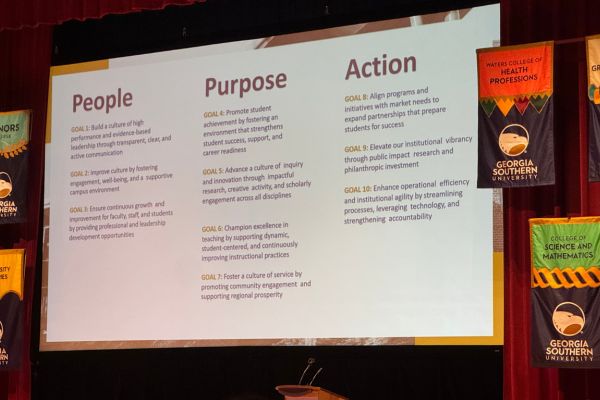
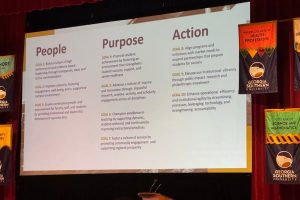
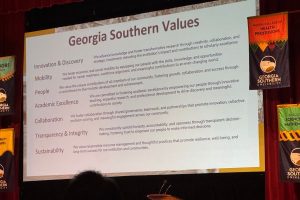
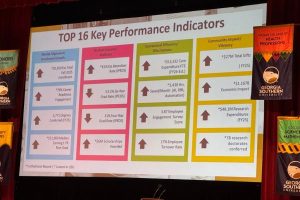
In closing, President Marrero encouraged faculty and staff to think about Georgia Southern’s posted values and the 10 goals outlined in the People, Purpose and Action framework, so as to meet and exceed the 16 key performance indicators.
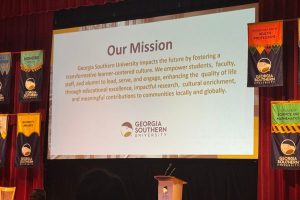
“Our mission at Georgia Southern is transformation,” he said, “At the end of the day, everything will always be measured in terms of the success of our students, the story they tell.”