

Walk through downtown, and Savannah College of Art and Design has an unmistakable imprint. Its expansion includes historic building acquisitions and cultural initiatives; these have transformed the city’s economic and cultural landscape, making the top-ranked university a central driver of growth and development.
SCAD’s contributions are substantial, with their most recent community impact study stating the college generated $1.3 billion in economic impact in Georgia in 2023. Through SCAD SERVE, the college’s outreach program, the school has funded community projects like playgrounds and murals. Student foot traffic, cultural events and restored architecture infuse the city with energy.
The Student Housing Squeeze
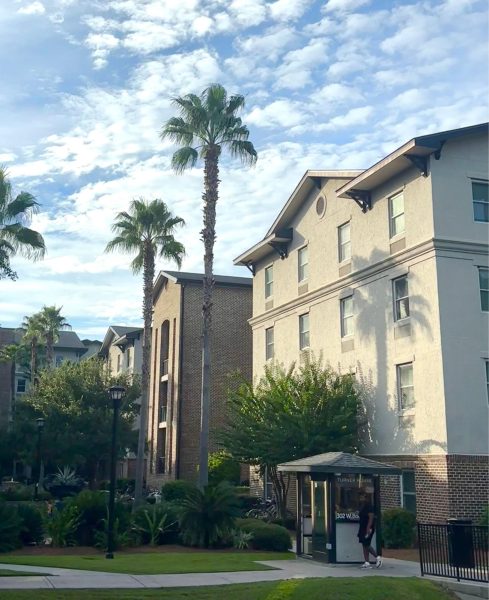
But SCAD’s growth has intensified housing pressures. Students face increasing difficulty finding affordable housing, as on-campus housing is limited and costs more than $10,700 annually. In a WSAV report, Jeff Stewart, the father of a SCAD student, described how his daughter was waitlisted for university housing and compelled to rent off campus at a significantly higher cost.
Laura Lane McKinnon, executive director of Housing Savannah, Inc., contends that the housing tension in Savannah reflects a broader affordability crisis. SCAD officials have acknowledged the increased demand for student housing and highlighted steps to address it – without acknowledging it as a crisis. When construction delays postponed the opening of a new hall on Indian Street, the university stated the setback was beyond its control and arranged for students to be housed at Ann Street Lofts at no additional cost.
Neighborhood Shifts
The strain extends beyond students. When SCAD purchased the Chatham Apartments, longtime residents of the low-income high rise, like Gerrylyn Harvey, were displaced and forced to find new homes. McKinnon also addressed this by stating, “When you combine those pressures with strong student demand, it becomes very difficult for other citizens to compete, especially low- to moderate-income households.”

“When SCAD acquires existing properties, whether for dorms, classrooms, or administrative uses, it inevitably reshapes surrounding neighborhoods,” McKinnon said. The pace of change can accelerate gentrification, making it harder to preserve mixed-income communities. Still, McKinnon emphasizes that solutions exist.
“The bigger issue for Savannah is that we don’t have enough housing at the price points most people can afford, whether they are students, working families, or seniors,” she said. McKinnon proposed that expanding zoning to allow for duplexes, accessory units, and co-living options could help, as could preserving naturally affordable homes. McKinnon also suggests exploring community benefit contributions, such as a payment in lieu of taxes (PILOT), a model used by universities like Harvard.
Steps Toward Affordability
For McKinnon, the key is balance. “The best approach is to bring partners together — city, county, nonprofits, business, and institutions like SCAD,” she said. “It’s less about pointing fingers and more about making sure growth doesn’t leave residents behind.”
Savannah’s growth has brought both opportunity and challenges. In March 2025, the City Council approved an Affordable Housing Overlay District to facilitate higher-density development in select neighborhoods, with an aim to increase housing supply. Subsequently, in April 2025, the Council approved specific zoning map amendments to implement this overlay in areas like the Thomas Square, Metropolitan, and Victorian District neighborhoods.
In Feb. 2025, construction began on a 16-unit affordable housing development on MLK Jr. Boulevard, providing much-needed housing for small families. Despite these efforts, approximately 40% of Savannah households are unable to afford quality housing, as reported by the Housing Savannah Action Plan. Addressing this issue requires continued collaboration and thoughtful planning to ensure that all residents benefit from the city’s growth.
Updated Oct. 3, 2025 to reflect accurate attribution to Laura Lane McKinnon.