


For fellow creatives, those lost in writer’s block, and anyone hoping to reconnect with their creativity…
To put it into perspective, imagine looking back at your 6-year-old self who wanted to become a painter, singer, or dancer simply because it brought you joy. No one was in your ear, pointing out the challenges, the doubts, the criticism, or the unrealistic standards you had. When we are young and naive, people smile at our curious ambitions, ask encouraging questions, and shield us from the harsh truths that come with growing up. Things change as we become adolescents and young adults. Doubts start to creep in. Outsiders form opinions. Goals that once seemed clear become distant daydreams, fading in the fog of responsibility into mere figments of imagination. Favorite hobbies compete for our time: time for work, time for papers, time for cleaning, time for studying. The activities we loved are often put aside, pushed behind the demands of daily life.
But art, in any form, never truly leaves us. Creativity is a source of survival, an outlet to connect with others, and a hug when times are rough. As Susan Magsamen, founder and executive director of the International Arts + Mind Lab, an applied neuroaesthetics initiative at the Johns Hopkins University School of Medicine, explains, “Artists, philosophers, and children have always known the power of the arts… in fact, the science shows we’re neurobiologically wired for these kinds of experiences, and they contribute to our health and well-being.” (Weir 2025)
Healing through Creativity.
Art supports mental health. Since the 1940s, there have been countless studies showing that art can heal. The simplicity of creating or experiencing art can influence the brain, according to The Intersection of Art and Health: How Art Can Help Promote Well-Being by the Mayo Clinic Press Editors (2023). Licensed professionals use art as therapy to treat conditions such as mood disorders, anxiety, post-traumatic stress disorder, and even dementia and Parkinson’s disease.
In the brain, art increases serotonin levels, improves blood flow to the part of the brain associated with pleasure, fosters new ways of thinking, and helps people imagine a more hopeful future. You might use art to support your own well-being without even realizing it. By doodling when you feel stressed or playing an instrument at the end of a long day. Artistic expression and appreciation are not only enjoyable but also have the potential to benefit your overall well-being (Mayo Clinic Press Editors, 2023).
A notable aspect of art and expression is seen in nonverbal children on the autism spectrum. It’s a universal form of communication that allows people to connect, heal, and be understood by expressing feelings through colors, sounds, or movement rather than words. Not only does it help them communicate with adults, but it also encourages friendships and connections with children their age. A child’s creative abilities are something that teenagers envy and adults tend to forget.
Making sense out of life

People have a life to live; most don’t focus on poetry in their everyday lives.
There are taxes, workloads, and jobs that make it nearly impossible to sit down and analyze a verse. It’s simply not a concern. That’s until life shifts. You’re at a funeral, you lose a friend, you love someone so much you can’t find the words to express it, someone breaks your heart, you feel weak, and all of a sudden, the need for human creativity becomes unfathomable. Reaching for books to find explanations for what feels like inexplicable sentiments, scanning for answers in the margins.
Has anyone felt like this before?
Scrolling through films to find one that makes you feel understood or even laugh so hard that you’re distracted from reality. Loving so hard that you’re spiraling, dizzy, and discovering music that mirrors those emotions almost to perfection. Escaping by creating art, knitting, crocheting, cooking, singing, and writing, filling in gaps in time for the pleasure of using the scope of your imagination. Unconsciously, people frantically try to make sense out of life through human creativity.
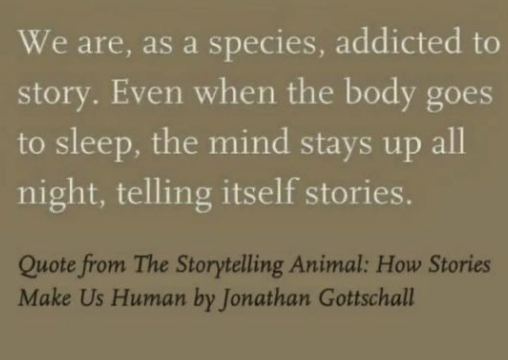
Whether through music, theater, handcrafted projects, movies, literature, or paintings on canvas or public walls, art always tells stories. It transforms our emotions, our struggles, our victories, and the direction our lives are taking into something plausible that we can understand.
Ways to bring your creativity back to life:

- Go back to where inspiration strikes. It’s true, our ambitions and dreams dim down like old lightbulbs, yet that inherent desire still flickers, and the things we once loved and yearned to learn remain a part of us. Here are some psychological ways to promote creativity:
- Trigger ingenuity. Change your environment and move around when working on a project. A lot.
- Get emotional. Ever wonder how people come up with the most unique insults when arguing? Both strong and negative emotions are linked to creative thinking!
- Surround yourself with the color blue!
- Humans associate the color blue with the sky, nature, tranquility, and safety; the reflection of the color subconsciously encourages us to think outside the box. According to a National Geographic study, researchers realized that “blue hues…encourage them to explore and try new things and boost creative thinking,” as opposed to any other color.
- Limit distractions→Daydream.
- Separating yourself from devices that alienate your train of thought. Get alone and get lost in thought; don’t force it, it’ll come to you eventually!
~~~~~~~~~~~~~~~~~~~~~~~~~~~~~~~~~~~~~~~~~~~~~~~~~~~~~~~~~~~~~~~~~~~~~~~~~~~~~~~~~~~~~~~~
Another way to reconnect is to join a club that nurtures your passions. Georgia Southern offers hundreds of organizations where you can explore creativity, meet like-minded peers, and grow your skills and curiosity. Here are some student-led arts and literature-focused clubs on both the Statesboro and Armstrong campuses:
- Fiber Arts Club. (Armstrong)
- Creative Writing Club (Armstrong)
- Club Mud (ceramics club!) (Armstrong)
- Theatre South (Statesboro)
- The Black Book Club! (Statesboro)
With over 300 clubs at Georgia Southern, there’s a space for everyone to explore their passions.
Do you want to showcase your club? Reach out to us!
Feature your Club/Organization in the George Anne!
References:
Mayo Clinic Press Editors. (2023, October 16). The intersection of art and health: How art can help promote well‑being. Mayo Clinic. https://mcpress.mayoclinic.org/living-well/the-intersection-of-art-and-health-how-art-can-help-promote-well‑being/
Weir, K. (2025, September 1). What happens in the brain when we experience art: How to unleash the power of neuroaesthetics for health, well‑being, and social change. Monitor on Psychology, American Psychological Association. https://www.apa.org/monitor/2025/09/art-mind-brain
Cherry, K. (n.d.). 10 Psychological Tricks to Boost Creativity. Denver Health Medical Plan Blog. https://www.denverhealthmedicalplan.org/blog/10-psychological-tricks-boost-creativity
Yong, E. (2009, February 5). Colouring your mind – red improves attention to detail, blue boosts creativity. National Geographic. https://www.nationalgeographic.com/science/article/colouring-your-mind-red-improves-attention-to-detail-blue-boosts-creativity