


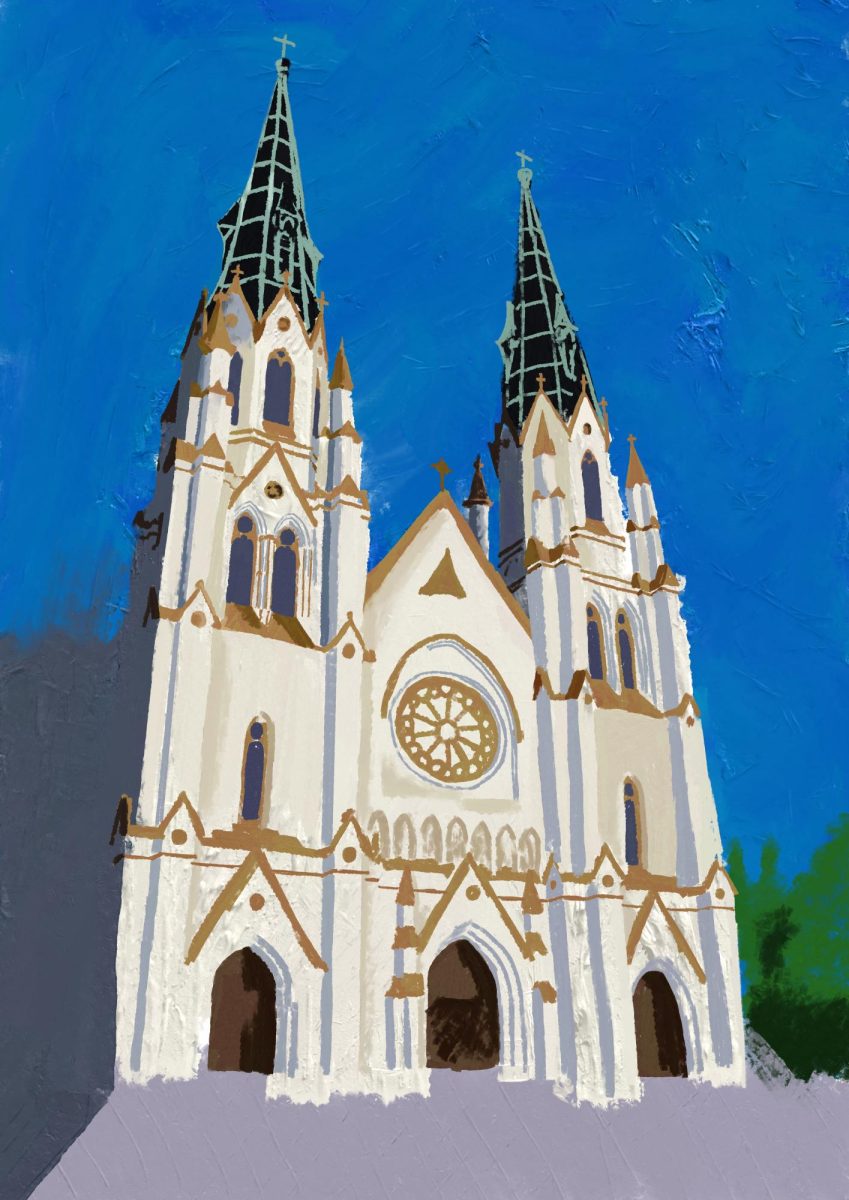
Feb. 18 was Ash Wednesday, an important holiday within the Catholic faith. For those of us outside the faith, there might be some questions about why a friend in class has an ashen cross on their forehead. Hopefully, I’ll be able to answer this and some of your other glaring questions, as well as provide some insight into the history of our local Catholic congregation.
Ash Wednesday is a Christian holiday that is widely celebrated by the Catholic church, although it is also observed by many other protestant denominations. It specifically marks the beginning of Lent, or 40 days of vegetarian fasting and prayer — 46 including the six Sundays — leading up to Easter Sunday. This time represents the 40 days that Jesus spent fasting in the desert. Ashes from burned palm leaves are placed on the head, either directly on the forehead in the shape of a cross or sprinkled atop the head, and the words “Memento, quia pulvis es, et in pulverem reverteris,” are given, meaning “remember, that thou art dust, and to dust shalt thou return.”
Other traditions are widely observed on Ash Wednesday and the 40 days of Lent, such as the “Lenten sacrifice” where one is to give up their vices, commonly seen in abstinence from smoking or sugary foods, alongside the regular fasting for the 40 days.
This is also in connection with the other common tradition known as “Almsgiving,” where any money that would have gone towards those vices is instead given to the poor as an offering. The last week of Lent, called Holy Week, begins with Palm Sunday, where palm leaves are burned in commemoration of the return of Christ to Jerusalem, and a feast is held. The ashes from these leaves are then saved to be used for next year’s Ash Wednesday ceremonies.
The Cathedral Basilica of St. John the Baptist is located on 222 Harris St., Savannah, GA., and is the oldest cathedral still standing within the city, as well as one of the first Catholic congregations in all of GA. The congregation was started in the 1790s by French immigrants fleeing Haiti, and their first church was built in 1799, which was the first Catholic church in Savannah. Another church was constructed in 1811 as the congregation grew in size, before the current cathedral was constructed in 1876. In Feb. 1898 a fire destroyed most of the original building, but construction efforts were fast enough to be finalized by Christmas of the same year. The building would then go on to have minor renovations throughout the next century, before being designated as a “minor basilica” by Pope Francis in 2020, one of only 152 within the entire continent.