

-
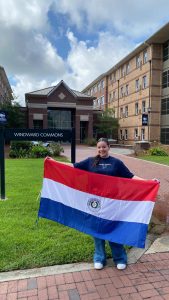
Ximena’s first day at Georgia Southern as an exchange student. August 2025, photo provided by Ximena Delgado Martinez

-
Dr. Diana Serrano talking to a student about the department of world languages and cultures. August 2022, photo provided by Dr. Diana Serrano
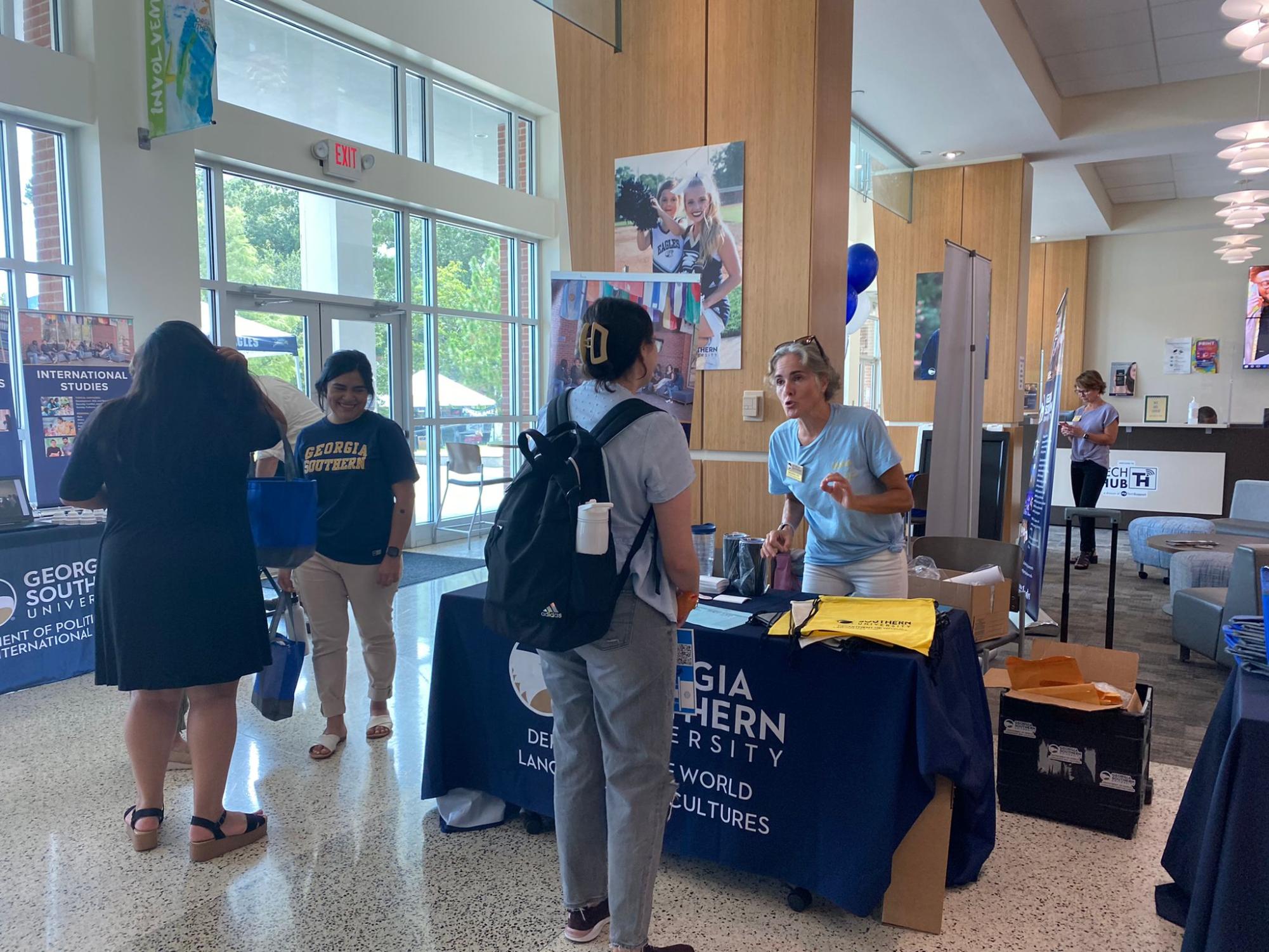
“Learning a language is challenging, and I don’t want to sugarcoat it,” said Diana Serrano, Ph.D., senior lecturer of Spanish. “It’s like any skill. It takes practice, repetition and persistence, but if you put in that, the rewards are huge.”
For many students, learning a second language is a requirement and not a desire. It’s a challenge that begins long before they fully understand its value.
Ximena Delgado Martinez — a third-year computer science engineering major and exchange student from Paraguay — began learning English in second grade.
“My dad and my mom, they put me in like a private institute to start learning English, and during my whole life that was nonnegotiable,” Delgado Martinez said.
Professor Serrano argues that even basic proficiency can provide a competitive edge.
“You have about 50 million Spanish speakers in this country regardless, so even knowing a little bit of Spanish gives you a comparative advantage when looking for a job,” she said. “Even if you gain that little proficiency, it is an asset.”
For Delgado Martinez, English proficiency created opportunity.
“That helped me to be here. I have a scholarship from Rotary, my club, and they needed enough people that could speak English and a person that would be able to translate.” she said. “In my club, there were like 40 people. And from those 40 people, I was the only one able to do that.”
Professor Serrano believes that having these language skills signal cultural awareness, and finding courage in a place that is not your own.
“You’re better off learning a little, some or more Spanish,” said Professor Serrano. “It tells employers that you are culturally competent, that you have cultural awareness to move about in a diverse society like the United States.”
The Difficulty of Finding Your Voice
“When I was back home, I was really worried about making mistakes, and like, people would laugh at me. Here I’m like, it’s okay. They know that I’m an international student, and English is not my first language, so if I made a mistake, they’re not gonna say anything.”
Being proficient in another language does not necessarily mean you can accurately represent yourself and your personality while speaking in that language.
“Socializing in a different language and being your own personality in a different language is really hard. Finding your own voice in a different language is hard,” Professor Serrano said. “There’s like a layer there of translation that is missed. You never quite feel yourself in English … there’s a sort of film that filters everything. I’m 55 and I still feel that way.”
Despite the frustration, the embarrassment and the long hours of practice, both Professor Serrano and Delgado Martinez agree that the discomfort is part of the process.
“It takes bravery to speak a language that’s not yours.” said Professor Serrano “It takes bravery to be comfortable making mistakes. It takes bravery to say it wrong and not come out the way you want it.”
“Even if it’s hard, keep trying, keep learning, keep doing your best, because it’s going to help you a lot.” said Delgado Martinez. “It’s going to open a lot of doors for you.”





Tracy Pierre • Mar 6, 2026 at 1:21 pm
Amazing article!