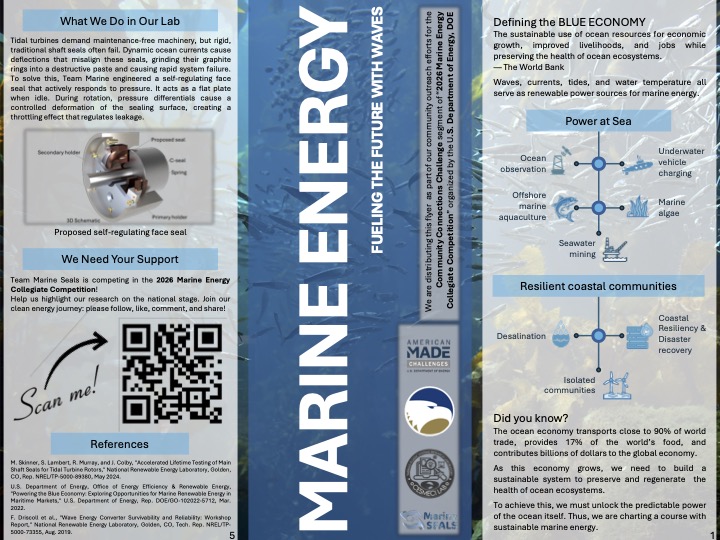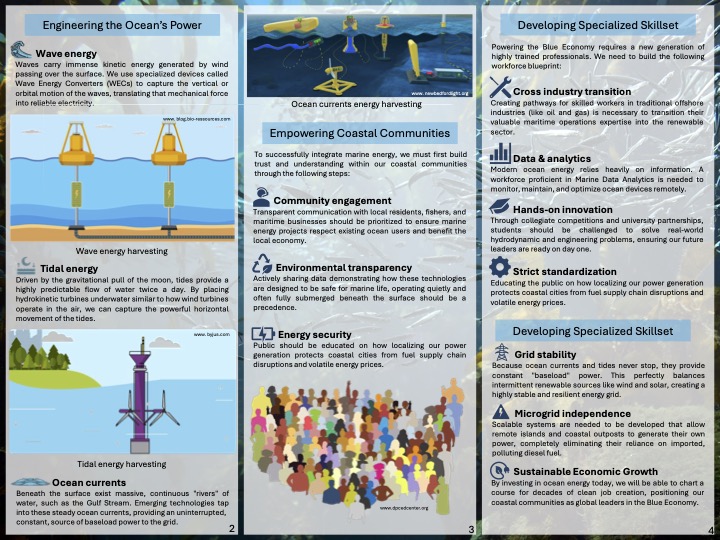


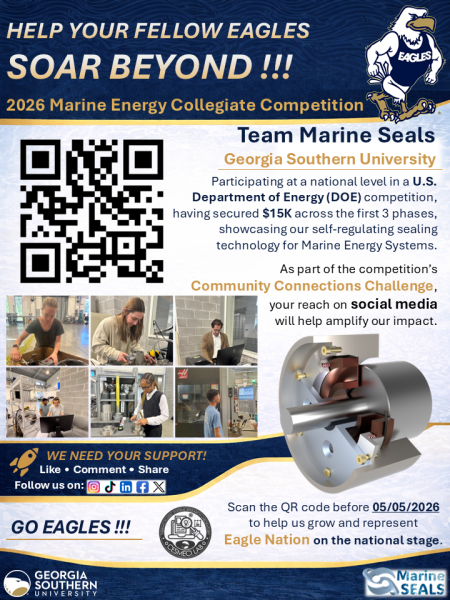
A student research team at Georgia Southern University is earning national recognition in the 2026 U.S. Department of Energy (DOE) Marine Energy Collegiate Competition (MECC), securing $15,000 across Phases I, II, and III.
But their work focuses on something most people never think about: a seal.
Led by Dr. Sevki Cesmeci, associate professor of mechanical engineering, Team Marine Seals is tackling one of the most common failure points in tidal turbines — which harness the energy of moving tides to produce electricity. These systems operate in harsh ocean environments, where constant motion, pressure changes, and limited maintenance access make reliability a major challenge.
 Seals are a critical but often overlooked component in tidal turbine systems. If a seal fails, the entire system can fail.
Traditional seals wear down over time due to continuous contact with rotating components. In offshore systems, where maintenance can take years, that’s a critical limitation. The team’s solution is a self-regulating seal designed to adapt to pressure changes and reduce wear, improving long-term performance in marine energy systems.
Marine energy, which includes power generated from waves, tides, and ocean currents, is an emerging renewable resource with applications ranging from desalination to coastal resilience. However, the field is still developing, and many engineering challenges remain.
“The industry is still young, and reliability is one of the biggest concerns,” said graduate student Mohammad Fuad Hassan.“If something fails offshore, you can’t just go fix it right away. Systems need to last for years.”
As the team advances to the final phase of the competition, their focus has expanded beyond technical development. Based on feedback from DOE and national lab reviewers, they are working to better communicate their research and connect it to real-world impact.
That shift has led to increased outreach efforts, including interviews with industry professionals, social media campaigns, and participation in campus events like the PCEC Student Research Symposium.
Recent student-led outreach has already reached thousands of viewers online, and the team is continuing to build a more engaging and accessible way to share their work.
Rather than presenting their project as just a new component, the team is reframing it as a solution to a larger system-level challenge: improving the reliability of tidal energy systems as a whole.
The goal of the team’s outreach is to help people understand how their innovation serves the bigger picture in renewable energy. It’s not just about the seal — it’s about making marine energy systems more reliable and practical.
With strong technical results and a growing emphasis on communication, Team Marine Seals is not only competing at a high level but also helping make complex engineering challenges easier to understand.
To learn more and support the team, scan the QR code on the flyer and follow their updates across campus channels.